
Modify the values below to personalize the article:
Table of Contents
Toggle
What is the ideal weight?
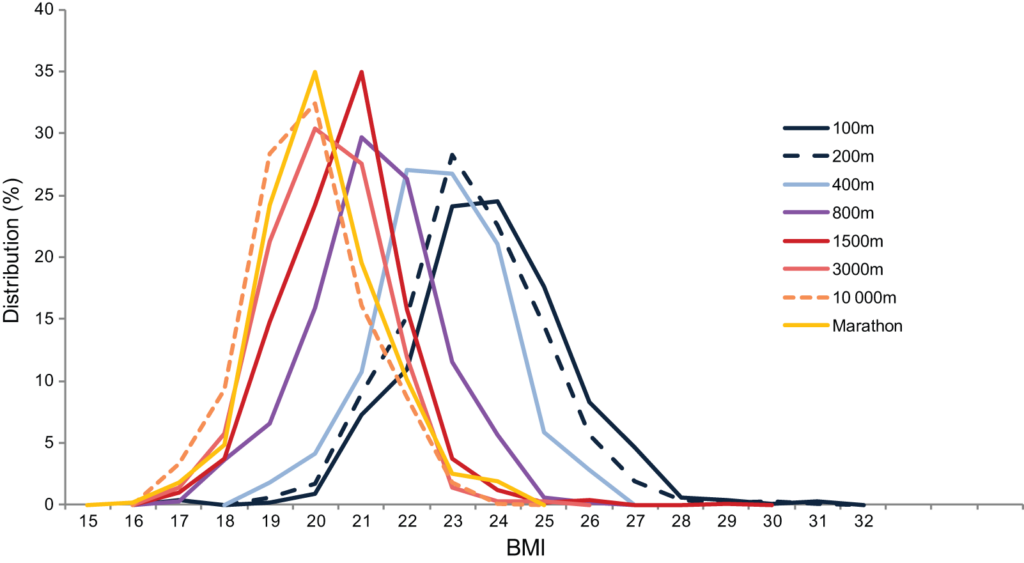
Ideal weight refers to a body weight considered optimal for an individual’s health, based on various criteria such as height, age, sex, muscle mass, body composition, and activities. Ideal weight also depends on personal aspirations and what one aims to achieve with their body. For instance, a study conducted by Sedeaud et al. analyzed the BMI of athletes based on running events and showed that marathon runners tend to have a lower body mass compared to 100-meter sprinters, even at the same height. [1]
Mathematical formulas: variable and limited results
Ideal weight formulas aim to estimate a theoretical weight based on parameters such as height, sex, age, or body type. However, their results often vary depending on the approach and have certain limitations. For example, the Broca formula, simple and easy to remember, relies solely on height. It is often cited as the basis for other formulas, even though its results can sometimes be too approximate.
Ideal weight (kg) = Height (cm) – 100Example: For a person measuring 170 cm, the ideal weight would be 70 kg. The Lorentz formula improves upon Broca’s by introducing an additional adjustment based on sex. It is particularly popular in countries using the metric system.
- For men:
Ideal weight (kg) = Height (cm) – 100 – (Height (cm) – 150) ÷ 4
- For women:
Ideal weight (kg) = Height (cm) – 100 – (Height (cm) – 150) ÷ 2.5
- For men:
- For men:
Ideal weight (kg) = 50 [kg] + 2.3 × {Height (in inches) – 60}
- For women:
Ideal weight (kg) = 45.5 [kg] + 2.3 × {Height (in inches) – 60}
Ideal weight according to the Broca, Lorentz, and Devine formulas:
- Broca Formula: Calculating...
- Lorentz Formula: Calculating...
- Devine Formula: Calculating...
The Perrault formula introduces age as a parameter to reflect body changes associated with aging, resulting in an ideal weight that increases with age.
Ideal weight (kg) = Height (cm) – 100 + (Age (years) ÷ 10 × 0.9)Example: A person measuring 170 cm and aged 30 years would have an ideal weight of 72.7 kg, while at 70 years old, their ideal weight would be 76.3 kg.
Ideal weight according to the Perrault formula: Calculating...
Finally, the Creff formula goes a step further by taking into account an individual’s body type (normal, large, or slender-gracile).
- Normal body type:
Ideal weight (kg) = Height (cm) – 100 + (Age (years) ÷ 10 × 0.9)
- Large body type:
Ideal weight (kg) = Height (cm) – 100 + (Age (years) ÷ 10 × 0.9 × 1.1)
- Slender-gracile body type:
Ideal weight (kg) = Height (cm) – 100 + (Age (years) ÷ 10 × 0.9 × 0.9)
Ideal weight according to Creff formulas:
- Normal morphology: Calculating...
- Large morphology: Calculating...
- Gracile morphology: Calculating...
Towards body mass index (BMI)
Mathematical formulas, useful but imperfect, have been supplanted by the Body Mass Index (BMI), which today assesses corpulence by comparing height and weight to standardized thresholds, rather than calculating an “ideal” weight. BMI calculation:
BMI (kg/m²) = Weight (kg) ÷ Height² (m²)BMI is a standardized measurement recognized by the World Health Organization (WHO) for determining health risks. It is calculated by dividing weight (in kilograms) by the square of height (in meters). The WHO has defined categories for interpreting BMI: a BMI below 18.5 is considered underweight, between 18.5 and 24.9 normal weight, between 25 and 29.9 overweight, and 30 or more obese (with varying degrees). These thresholds raise awareness of health risks, such as malnutrition for low BMIs, or chronic diseases like diabetes and cardiovascular disease for high BMIs.
Legend:
Underweight
Normal weight
Overweight
Mild obesity
Moderate obesity
Severe obesity
Selected point
The BMI limits set by the WHO are highly standardized, which means that individual variability cannot be taken into account. For example, the natural tendency of BMI to be higher in men than in women is not incorporated into these thresholds. What’s more, these categories do not always reflect a precise correlation with survival rates, as demonstrated by the curve of mortality risk as a function of BMI, derived from recent data from the vast American NHANES cohort [2]. Furthermore, mortality is generally higher for low BMIs, often associated with insufficient muscle mass, and for high BMIs, where excessive accumulation of fat mass can increase the risk of cardiovascular and metabolic diseases. This analysis underlines the limitations of the standardized approach, and highlights the importance of contextualizing BMI interpretations according to individual characteristics and study populations.
In this way, the risk of death can be further personalized by taking into account gender, age and BMI.
However, while BMI is an indicator of corpulence, it does not distinguish between muscle mass and fat mass. So, for athletes or very muscular people, BMI may not be a reliable indicator of health risk.
Summary
You’ve seen various formulas for estimating ideal weight, all of which take more or less information as input to the calculation.
This approach has now been replaced by BMI. According to the WHO, a normal BMI is between 20 and 25 kg/m2.
This definition has the advantage of simplicity, but if you want the “ideal weight” to reflect a mortality risk, larger intervals can be used, particularly according to recent cohorts.